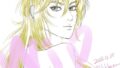
Melancholy of Ganymede Milo & Camus — An Unspoken Story
✦ Introduction ✦
This is the English version of Melancholy of Ganymede, a character-driven story set in the world of Saint Seiya, between established canon events.
Rather than retelling what is already shown, this piece dwells in what canon leaves unsaid:
the silence between orders and action, the pressure that precedes grief, and the restraint required of those who teach, command, and endure.
Set between Hyoga’s disciplinary orders and the confrontation at the Palace of Aquarius, the story follows Milo of Scorpio as he observes the fractures forming within Camus of Aquarius—fractures shaped by duty, loss, and the impossibility of emotional detachment.
This English translation was produced with the assistance of ChatGPT, under my direct supervision, with careful attention to preserving the restrained tone, ethical tension, and emotional subtext of the original Japanese text.
✦✦✦
Japanese version:
Read the original text in Japanese
Melancholy of Ganymede
Milo & Camus — An Unspoken Story
I might have been the only one who sensed that something was off.
Camus’s remarks about Hyoga had troubled me lately.
He opposed the Pope’s decision to send Hyoga to the Galaxian Wars in Tokyo, claiming “his strength is still insufficient,” lowering his own disciple before the Pope.
Camus, of all people, should have had no objection to punishing the farce called the Galaxian Wars, where the power of Saints was being used for private ambition.
Hyoga had already been granted the right to become a Saint by the Pope, yet Camus withheld the Cloth.
Hyoga received it only when the Pope issued a corrective order.
Why did he refuse to acknowledge his disciple to that extent?
Such behavior could cast doubt on Camus’s ability as a mentor.
He cannot be unaware of this.
“Camus.”
When I visited the Palace of Aquarius,
Camus, its master, wore the same cold expression as ever.
With that expression unchanged, he had stepped outside the hall and was gazing into the distance.
“What are you looking at?”
I called out to him.
His long hair, the color of young green, stirred in the wind as he turned toward me.
“Milo.”
Camus answered in that manner, then added,
“Has something happened?”
“Another assassin has been sent after the Bronze boys in Tokyo.
This time, a Silver Saint.”
At my reply, Camus’s expression clouded, only slightly.
“Who went?
Milo.”
“What troubles you?”
When I listed the assassins—beginning with the Lizard Saint—
Camus’s complexion returned to its usual composure.
What lay behind that regained calm, I could not yet grasp.
The ambiguity drew me further toward his disciple.
What kind of man was Hyoga?
Camus had opposed the Pope’s punitive order, saying
“Hyoga is not yet strong enough.”
And yet, hearing the names of the Silver Saints
did not unsettle him in the least…
“You seem certain.
Hyoga would not struggle against a Silver Saint, would he?”
“…Among those I trained, he achieved the highest discipline.”
Camus turned once more toward the sheer cliffs
linking the Sanctuary to Athens.
His attention drifted away from my words,
as if his thoughts had moved elsewhere entirely.
“A remarkable talent, then.
You shaped him with such care, and he chose another path.
That must weigh on you.”
Camus did not reply.
Hyoga had been ordered by the Sanctuary
to eliminate the Bronze Saints,
yet in Tokyo he had refrained from striking them down.
Reports said he even fought alongside them,
resisting the Silver Saints in their stead.
Now Hyoga himself stood among those
the Sanctuary would punish.
“I have been given an order of enforcement as well.”
Camus’s expression shifted at once.
“What? Where are you going?”
His face tightened, and he seized my arm.
“Andromeda Island.
The task is to deal with the Saint of Cepheus,
who ignored the Pope’s summons.
But I intend to hand that duty to Aphrodite of Pisces.
I will go to Tokyo instead.
I cannot allow further failures against the Bronze Saints.
The Silver Saints cannot be trusted to finish the job.”
“Stop.”
I gripped Camus’s arm in return.
His blue-green eyes held a controlled anger as he met my gaze.
“Why are you unsettled?
It is unlike you.
Hyoga is Hyoga.
He became a Saint to recover his mother’s body
from the seabed of Siberia.
You worried about him for years.
You said such resolve would never be enough
to become a Saint.
Yet he became your most accomplished disciple—
and then he turned away.
But there was another. Was there not?”
Camus’s eyes tightened further,
as if his anger pressed inward.
There was another—
before Hyoga arrived.
A disciple Camus once placed his hopes on.
The boy who was the center of his attention
until Hyoga became his pupil.
“…Isaak. What became of him?”
Camus answered without flourish.
“He died.”
His eyes dimmed,
not with a display of grief
but as though something receded from view
and refused to return.
“Hyoga dove into the Siberian sea
and did not surface.
Isaak followed him,
reached him,
and died.”
The Siberian tundra came to mind.
The ice field.
The sea that kills with its cold.
Then it aligned.
Why Camus withheld Hyoga’s Cloth.
Why he challenged the order to send him as a sanctioned assassin.
Why he wanted a Gold Saint to stay his hand from carrying out the punishment.
He does not want to lose Hyoga.
Not again.
Not as he lost Isaak.
“Camus.”
I held his arms and searched his face,
Camus lowering his brow as if steadying himself.
“If you forbid it, I will stay.
But you will take responsibility.
He is your disciple.”
Camus was silent.
Then he slipped from my grasp like moving air.
His face froze again.
The air around him dropped in temperature.
Even he cannot bury the rise within.
“I know.
Treason to the Sanctuary is death.
A disciple’s failure is mine to answer
—even at the cost of my life.”
At those words, something surfaced in my mind.
Camus facing Hyoga.
I could see it.
For all his words, he would never let Hyoga die.
—Then.
“Milo.
If you lay a hand on Hyoga,
I will not forgive you.
Not even you.”
Camus was sharp.
He caught my thought
from the faintest shift in me.
Yes.
He knows he cannot kill Hyoga.
That is why he can read me.
He sees the possibility that I might move first.
If Camus were ordered to eliminate Hyoga and failed—
that failure would break him.
Why would I allow such a foolish outcome.
A Gold Saint of Aquarius and a Bronze Saint cannot be weighed on the same scale.
The Holy War draws near.
We need the greater strength intact.
“Camus.
I believe you are a true Saint.
I will not interfere.
I leave Hyoga to you.
Do as you must.”
I could say nothing else.
We serve the Goddess, yes—
but we are not empty vessels
without blood or burden.
When I said that, Camus spoke.
“Milo.”
Then, without warning, Camus fell to his knees.
I reached him before he struck the ground.
“I told Hyoga to sever his attachment to his mother.
Yet I am the one who cannot sever mine—
not from Isaak,
not from Hyoga.
I lost Isaak.
I cannot lose Hyoga as well.”
Tears slid from his blue-green eyes,
as if something inside had finally cracked.
“I cannot strike down Hyoga.
So I give everything I have to him,
even this life.
And when he surpasses me—
he will know what that means.”
Camus looked at me.
In his eyes, a frozen fire burned on.
“I will face Hyoga with everything I have.
In that clash, he will rise—
perhaps to where I stand.
One Gold Saint of Aquarius is enough.
Watch over us, Milo.”
Strength gathered through my body.
I had sensed this coming—
the absence in Camus’s gaze,
the weight pressing in from elsewhere.
I could not have missed it.
I have watched him too long.
I let my expression soften, almost a smile.
“I will witness it, Camus.
But I do not wish for your death.
Remember only that.”
I touched his cold cheek.
Camus gave no answer,
as if unsure what I meant to hold back
and what I meant to let go.
“Think only of yourself.
I will bear the rest.
No matter how long you remain unsure,
I will support you.
So take all the time you need.
Live as you must.”
Camus held my gaze in silence.
His fingers brushed the backs of my hands
where I cupped his face.
“Milo.
I will not forget you.”
Even through the Cloth,
his hand carried its coldness,
drawing the warmth from mine.
My resolve remains:
to stay beside this man
and the weight of his restraint.
But if I could ask for one thing—
if only—
✦
The end
✦ About This Work ✦
This story explores a non-romantic M/M dynamic grounded in devotion, responsibility, and moral restraint rather than explicit affection.
There is no romantic resolution and no explicit content.
Instead, the narrative focuses on:
- the burden of mentorship
- the ethics of authority
- emotional inheritance between teacher and disciple
- and the quiet bond formed when one man bears witness to another’s restraint
Milo does not stand in opposition to Camus, nor as his salvation, but as the one who sees what Camus cannot voice—and chooses to remain.
This work is part of my broader explorations of Saint Seiya characters through silence, omission, and internal conflict, where meaning arises not from declaration, but from what is deliberately withheld.
You can find more of my work here:
- AO3 (InkSanctum):
English and French translations, plus other fiction
https://archiveofourown.org/users/InkSanctum - All works & links:
https://lit.link/amagaishuka - Main blog (articles, analyses, translations):
https://books-whitegoat.com/
✦ ✦ ✦